
How to Get More Physician Referrals: 11 Strategies for Canadian Specialists
Referral volume responds to specific, controllable things. The specialists who grow fastest market to referring physicians and to patients at the same time.
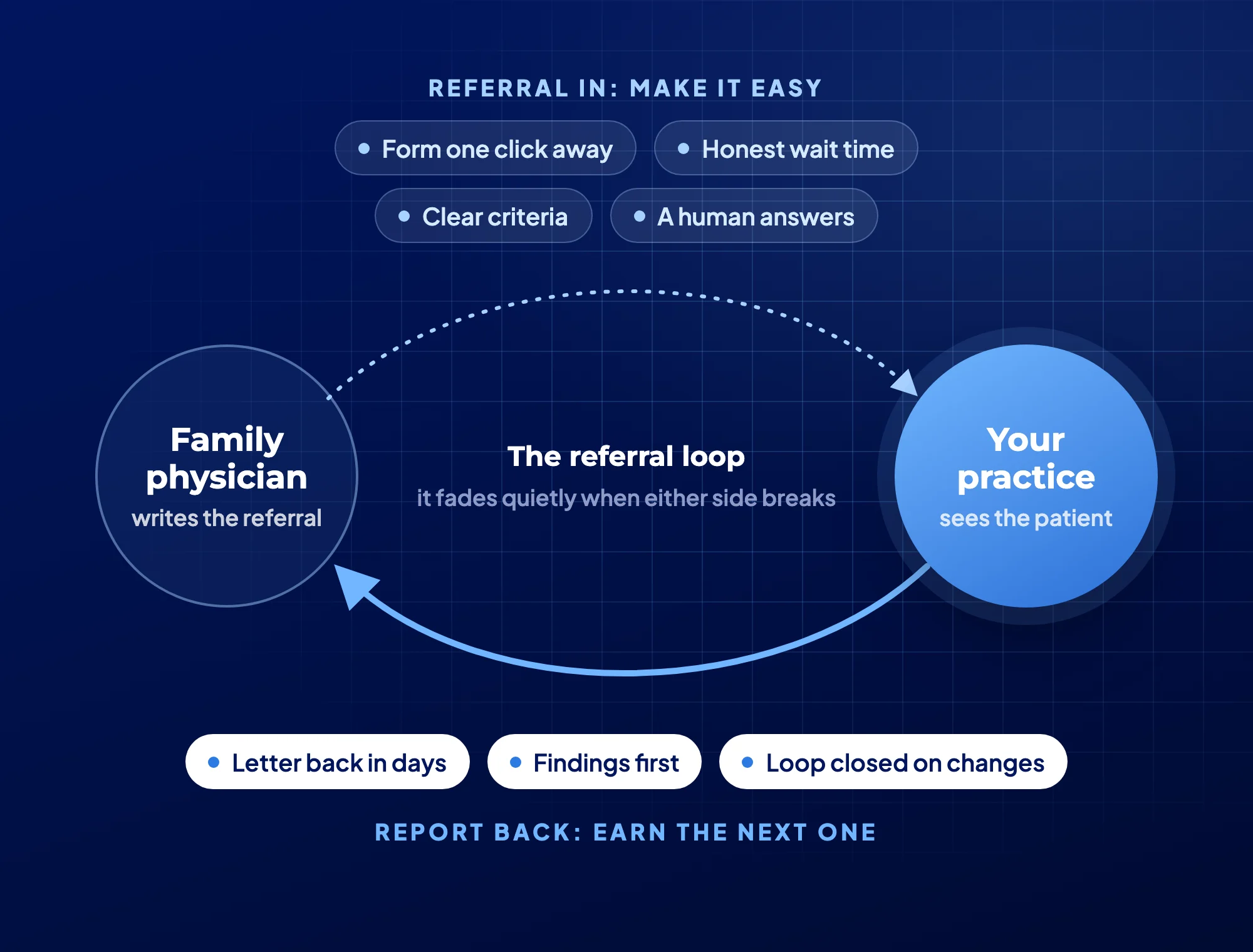
For most Canadian specialists, physician referrals are not one channel among several. They are the practice. A surgeon or consultant can have an excellent website and still sit with an empty clinic if family physicians are sending patients elsewhere.
Yet referral growth is rarely treated as something you can influence. It gets described as relationships, which sounds like something that either exists or does not. In practice, physician referrals respond to specific, controllable things: how easy you are to refer to, how quickly you report back, and whether the referring doctor remembers you at the moment they are writing the note. As a medical marketing agency working with Canadian specialists, we see these patterns often. Here are 11 strategies, grouped into three areas.
Why Physician Referrals Still Drive Specialist Growth in Canada
The Canadian system routes most specialist care through a family physician. Because of that, the referring doctor is one of your most important audiences, even though the patient is the one you treat.
Most people stop there. They assume a specialist’s marketing should speak only to referring physicians. In our experience, that is half the job.
Run Two Streams: Referring Physicians and Patients
The specialists we have seen grow fastest run two streams at once. One speaks to referring physicians. The other speaks to patients, and makes it very clear how a patient can raise your clinic with their family doctor and ask to be referred.
The reason is reach. A small group of referring physicians is hard to target directly. Making patients aware that your clinic exists is far easier. Once they know, patients start doing the work for you. They mention you to their family doctor, to their friends and to other providers, so the name spreads through clinics and through the community much faster than any physician campaign alone.
Then something compounds. When family physicians keep hearing your name, from patients and from colleagues, referring to you becomes the natural choice. They start sending you patients who never asked for you by name.
Patient facing advertising still falls under the college rules covered below. In Ontario, that means no testimonials, and no proactively contacting people known to need a particular medical service. Build awareness broadly and let patients come to you.
Make It Easy for Family Physicians to Refer to You
Most referral loss is friction, not preference. Remove the friction and volume moves.
1. Publish a Referral Form Anyone Can Find in Ten Seconds
Your referral information should be one click from your homepage and available without a login. If a physician’s office has to phone to ask how to refer, some of them simply will not.
Offer every route offices actually use, because each one has its own preference: a fax number, since many Canadian practices still rely on it, a downloadable PDF referral form, an online referral form, and a direct phone and email contact. Do not make an office adopt your preferred method to send you a patient.
2. State Your Wait Time Honestly, and Keep It Current
Referring physicians choose partly on access. Consequently, a clear and current wait time is one of the most persuasive things on your site.
An outdated figure is worse than none. If it changes, update it.
3. Be Explicit About What You Do and Do Not Accept
Inappropriate referrals waste everyone’s time and quietly damage the relationship. Publish your inclusion and exclusion criteria plainly.
Family physicians appreciate the clarity, and you receive better matched patients as a result.
4. Make Your Contact Route Reachable by a Human
A phone line that reaches a person, or an email that receives a reply the same day, matters more than any brochure. Referring offices remember which specialists are reachable.
Give referring offices a route that bypasses your patient booking line. Staff calling on behalf of a physician should not wait in the same queue as a patient rescheduling an appointment.
Build Physician Referral Relationships That Last
Access gets you the first referral. Reporting gets you the next twenty.
5. Send the Consult Letter Back Quickly
This is the single strongest driver of repeat physician referrals, and it is almost entirely within your control.
A letter that arrives in days rather than weeks tells the referring doctor their patient was handled. Slow reporting, on the other hand, is the most common reason a family physician quietly stops referring.
6. Write the Letter for the Person Reading It
Lead with what you found, what you did and what you need from them. Save the narrative for the chart.
A referring physician reading twenty letters in an evening will remember the one that respected their time.
7. Close the Loop When Something Changes
If the patient does not attend, or the plan changes materially, tell the referring office. It takes a moment and it builds unusual trust.
Family physicians carry responsibility for patients they have referred onward. Anything that helps them keep track of that is genuinely valuable to them, and very few specialists bother.
8. Meet the Practices That Refer to You Most
Identify your top referring clinics and visit them. Bring nothing to sell. Ask what would make referring to you easier.
Additionally, ask what they wish they could refer for and cannot find locally. Those conversations regularly reveal a service worth adding.
Being remembered also depends on your public profile, which our guide to personal branding for doctors covers in detail.
Market to Referring Physicians Without Breaking College Rules
Referral marketing sits under the same advertising rules as everything else you publish, and those rules are stricter in Canada than most agencies realise.
9. Keep Claims Factual and Non Comparative
In Ontario, physicians must not include statements comparing themselves to other physicians, nor suggest a better or more effective service than another provider. Those are explicit provisions of the College’s advertising policy.
Therefore, describe your training, your equipment and your access times factually. Let the comparison happen in the reader’s head. The CPSO advertising policy sets out the wording directly.
10. Build a Page Written for Referring Physicians
Most specialist websites speak only to patients. A dedicated referring physician page, with criteria, forms, wait times and contacts, is unusual enough to be memorable.
It is also a straightforward addition to any medical website design project and it tends to earn links from local practices.
Does the website actually matter for referrals? Yes, to both sides. Referring offices use it to find your forms and criteria, and referred patients look you up as soon as they hear your name. So add a section for patients too: what your practice treats, how the referral process works, how to ask their family doctor for a referral, and what to expect once it is sent. That page is also what feeds the patient stream above.
11. Track Which Practices Refer, and Which Stopped
Record the referring practice on every new patient. Review the list quarterly.
A practice that referred monthly and has gone quiet is a specific, solvable problem. Without tracking, you will not notice until the volume is already gone.
What Weakens Physician Referrals Without Anyone Saying So
Referral relationships rarely end in a conversation. They fade, and the specialist usually never learns why.
The biggest mistake we see is courting the physician and ignoring the office. In most family practices, the doctor decides a referral is needed, but the staff send it, chase it and field the calls when it stalls. When the doctor has no strong preference, the office often sends it wherever is easiest. Specialists who know the referral staff by name, answer their calls quickly and thank them get the benefit of that choice. Those who only ever speak to the physician usually do not.
Beyond that, slow reporting is the most common cause. Difficulty reaching your office is next. Patients returning confused about the plan follows, because the family physician then absorbs the follow up work.
None of those produce a complaint. Instead, the next referral simply goes somewhere else. That is why tracking referral sources quarterly matters more than any single marketing activity.
Grow Your Physician Referrals This Quarter
Start with reporting speed, because it costs nothing and it is the reason most referral relationships decay. Then fix the referral form and publish an honest wait time.
If you want help building the referral side of a specialist practice, our work with private and specialised clinics covers exactly this, and we also market to primary care physicians on the other side of the same relationship.
Want this working for your clinic? We build the search visibility, the website and the patient booking path for Canadian practices, and tell you plainly what to fix first.
Book a free consultation