AI SEO for medical clinics and healthcare providers is no longer a future concept, it’s already reshaping how patients discover doctors, clinics, and specialists in Canada and around the world. Instead of typing short keywords like “clinic near me,” people are increasingly asking longer, conversational questions and following up with more detail through AI-powered search experiences.
At the same time, Google is transforming the search landscape through AI Overviews and AI Mode, where the “answer” often appears first and the sources are selected based on trust signals, clarity, and topical authority, not just traditional keyword targeting.
This guide explains how AI SEO for healthcare actually works in 2026, in practical, clinic-operator terms: what to change on your website, what content to publish, how to strengthen trust signals, and how to position your medical practice to be recommended, not just ranked.
What is AI SEO for Healthcare?
AI SEO (sometimes called Answer Engine Optimization or Generative Engine Optimization) is the process of optimizing your online presence so AI-powered systems, like Google’s AI experiences and conversational assistants, can confidently reference and recommend your clinic.
Traditional SEO focused on:
- ranking a page for a keyword
- earning clicks from “blue links”
AI medical SEO adds a second battlefield:
- being used as a trusted source in AI-generated answers
- being selected when an AI is effectively “shortlisting” providers
That matters because in AI interfaces, patients often see fewer options. Being mentioned can become more valuable than being #3.
How patients search for doctors and clinics in 2026
AI changes what patients ask and how they ask it. Your medical SEO efforts need to optimize for both.
The three query types AI platforms reward
A useful mental model:
- Recommendation queries (“Who’s the best…?”)
- Condition/symptom queries (“I have X symptoms, what kind of doctor should I see?”)
- Location/availability queries (“near me,” “open now,” “accepting new patients,” “in Toronto,” etc.)
This query pattern framing shows up clearly in the best AI-SEO healthcare content currently ranking.
Why AI Mode and AI Overviews change SEO for medical practices
Google describes AI Mode as a way to search with more complex, detailed questions and follow-up exploration, with “helpful links to explore more on the web.”
In other words: Google still needs sources, but it chooses sources that are:
- clear and structured
- aligned to intent
- trustworthy (especially in health/YMYL)
- consistent with the clinic’s real-world identity
In healthcare marketing, accuracy and trust are even more critical. AI-generated health summaries have been criticized for how they surface disclaimers and for risk of misinformation, so Google has strong incentives to rely on credible sources.
The practical takeaway:
Your clinic’s online presence must look like the most reliable, comprehensive, and verifiable source for the exact questions patients ask.
The AI SEO framework that actually works for clinics
This is the core playbook. If you implement these sections, you’ll be ahead of most “AI SEO” articles currently ranking.
Build “entity clarity” across your clinic’s footprint
AI systems struggle with ambiguity. If your practice’s identity is inconsistent across the web, you become harder to recommend.
Entity clarity means:
- consistent clinic name, address, phone (NAP)
- consistent doctor names/credentials
- consistent specialties and service descriptions
- consistent business categories (especially for GBP)
This is why “entity profile consistency” is emphasized in the stronger doctor SEO guides.
Publish condition-led content, not only service-led content
Most clinics only publish pages like:
- “Psychiatry Clinic Toronto”
- “Hormone Therapy Clinic Vancouver”
That’s fine, but AI search rewards clinics that match how patients describe their problem.
Condition-led pages target queries like:
- “brain fog and hormones”
- “panic attacks treatment options”
- “persistent knee pain which specialist”
This strategy is specifically recommended by AI-healthcare SEO frameworks because it aligns with symptom/condition query behavior.
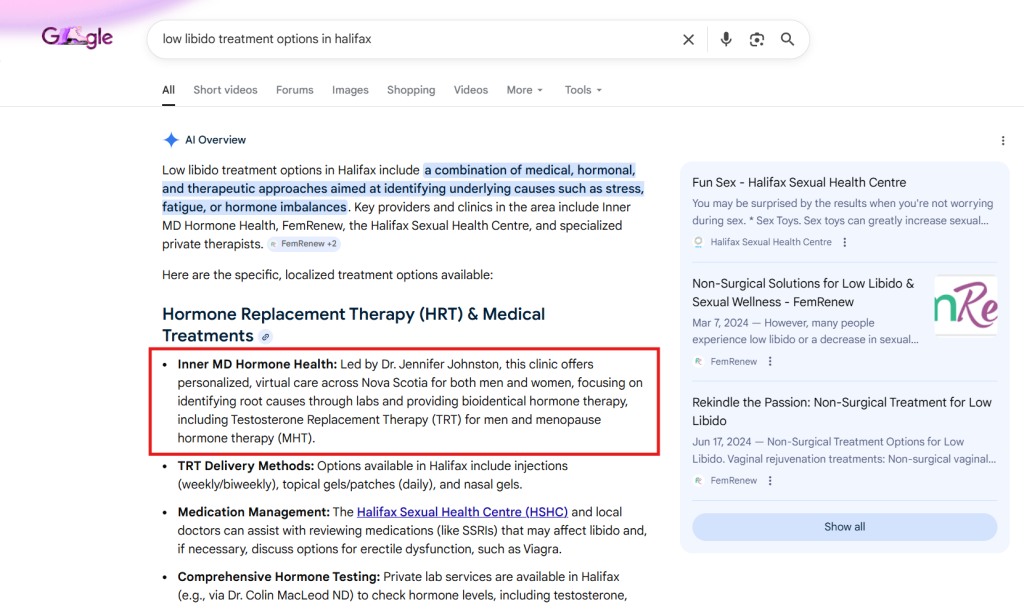
Condition page structure (copy/paste template)
- What is [condition/symptom]?
- Common causes and when to seek help
- How your clinic assesses it (diagnostic approach)
- Treatment options you provide
- What a first visit looks like
- FAQs (patient language)
- Clear next step (book/consult)
Make doctor and clinician profiles “quotable” for AI SEO
AI systems pull short excerpts. Your bio should contain clean, verifiable statements that can be quoted without context.
Include:
- credentials + licensing context
- clinical focus areas (specific)
- years of experience
- hospital affiliations (if applicable)
- publications / speaking / teaching
- languages spoken (Canada is multilingual in practice)
This “quotable profile” concept is a standout on the better AI SEO healthcare pages.
Add structured data that AI can interpret
AI systems don’t “need” schema to read your content, but schema reduces ambiguity and increases confidence.
For medical practices, prioritize:
- Organization / LocalBusiness
- MedicalClinic / Physician
- FAQPage (for your FAQ blocks)
- Review / AggregateRating (where legitimate)
- Service + area served (where applicable)
Also ensure your clinic’s:
- address
- hours
- phone
- booking URLs
…are consistent and crawlable.
Win trust signals (E-E-A-T) the Canadian way
Healthcare content is YMYL, meaning trust signals matter more than in most industries. YMYL stands for “Your Money or Your Life”, a phrase Google uses to distinguish any content that can potentially impact people’s happiness, health, financial stability, or safety.
Strong pages explicitly call this out: in health, quality and trust outweigh old-school keyword density tactics.
To strengthen E-E-A-T:
- Put author/reviewer details on clinical content (who wrote it, who reviewed it)
- Keep “last updated” dates real and meaningful
- Cite reputable sources when making medical claims
- Avoid exaggeration (“best,” “guaranteed,” miracle outcomes)
Canada-specific AI SEO considerations clinics can’t ignore
Privacy and consent expectations are higher in healthcare
Canadian clinics should assume that every marketing tool (forms, chat widgets, call tracking, analytics, CRM) is part of a privacy story. At a federal level, PIPEDA sets rules for private-sector organizations handling personal information in commercial activities.
In Ontario, PHIPA establishes rules around personal health information.
Practical website implications:
- Be intentional with form fields (collect what you need, not everything)
- Avoid putting sensitive health disclosures into unprotected intake forms
- Make privacy policy and consent language easy to find
- If you use third-party tools, document them and ensure your clinic understands the data flow
This isn’t just legal hygiene, it’s also a trust signal. In AI search, trust wins.
How ChatGPT Health changes patient discovery
OpenAI introduced ChatGPT Health as a dedicated health experience inside ChatGPT, designed with additional privacy protections and built with physician collaboration.
Why this matters for clinic AI SEO:
- More users will describe symptoms conversationally
- They’ll ask follow-up questions
- They’ll look for providers that match their condition narrative, not just a service keyword
So yes, ranking for “therapy near me” still matters.
But clinics that publish content addressing specific symptom journeys will increasingly be the ones that get surfaced when users ask complex, nuanced questions.
The 30-Day AI SEO Implementation Plan for a Medical Clinic
Implementing AI SEO for healthcare doesn’t require a full website rebuild. In most cases, it requires tightening foundations, clarifying your clinic’s digital identity, and expanding content in the right areas. Below is a structured 30-day roadmap that Canadian medical practices can realistically execute.
Week 1: Strengthen Your AI Medical SEO Foundations
Before creating new content, your technical structure must be clean and crawlable. AI search systems as of 2026 still rely on Google’s core index, so if your pages are difficult to crawl, slow to load, or inconsistently structured, you reduce your chances of being surfaced in AI-generated results.
Start by confirming that your most important pages are properly indexed. Review your sitemap, check for broken links, validate canonical tags, and ensure there are no duplicate or conflicting URLs. Page speed, particularly on mobile, should be optimized, as healthcare searches are heavily mobile-driven.
It’s also critical that key pages are fully crawlable. Avoid hiding essential content behind JavaScript-only tabs or expandable sections that search engines may not interpret reliably. Navigation should clearly reflect your services, conditions treated, and locations served. When AI systems analyze your site, they should immediately understand what you offer, who you serve, and where you operate.
Week 2: Build Entity Authority and Local Trust Signals
AI SEO for medical clinics relies heavily on entity clarity and trust. This week should focus on strengthening how your clinic appears across the web.
Start with your Google Business Profile. Ensure that categories are accurate, services are clearly listed, operating hours are current, and your description reflects your actual scope of practice. Small inconsistencies can weaken local authority signals.
Next, standardize your clinic’s name, address, and phone number (NAP) across major directories and healthcare platforms. AI systems evaluate consistency when determining whether your clinic is a credible entity.
Your “About” page and clinician profiles also deserve attention. Each provider should have a clearly written biography that includes credentials, areas of specialization, years of experience, and relevant affiliations. These details increase E-E-A-T (Experience, Expertise, Authoritativeness, Trustworthiness) signals, particularly important in healthcare, which is classified as a YMYL (Your Money or Your Life) category.
Finally, implement a structured and ethical review acquisition process. Reviews contribute not only to local SEO, but also to perceived trust, which can influence AI-generated recommendations.
Week 3: Publish AI-First, Condition-Focused Content
Once your technical and entity foundations are strong, shift toward content expansion. AI SEO rewards topical depth, particularly around symptoms and conditions, not just service names.
Begin by identifying three to five high-intent condition topics that align with your core services. These should reflect how patients actually describe their problems, not just the clinical terminology. For example, instead of only targeting “orthopedic surgeon Toronto,” you may create pages addressing specific concerns like chronic knee pain, ACL injuries, or post-surgical recovery expectations.
Upgrade clinician profiles where needed, ensuring they contain clear, quotable statements about areas of expertise. AI systems often extract concise summaries when presenting provider information.
Add at least one “What to Expect” page that outlines your intake process, appointment flow, and treatment approach. This type of content reduces patient anxiety and increases conversion rates, while also providing structured, extractable information for AI platforms.
Week 4: Package Content for AI Extraction (AEO Optimization)
In the final phase, focus on structuring your content so that AI systems can easily interpret and reference it.
Add FAQ sections to your highest-value pages using clear, question-based subheadings. These FAQs should reflect real patient queries and use natural language. Structured FAQ blocks increase the likelihood that your content will be selected in AI-generated summaries.
Implement schema markup where appropriate, including MedicalClinic, Physician, FAQPage, and Review structured data. While schema does not guarantee AI inclusion, it reduces ambiguity and strengthens entity clarity.
Review your internal linking structure. Ensure that condition pages link logically to service pages, and that service pages guide users toward booking or consultation pages. This creates a clear topical hierarchy that both users and search engines can follow.
Finally, begin tracking the right metrics. In addition to rankings, monitor impressions, branded search volume, and the quality of inbound calls or leads. AI SEO is not just about visibility, it’s about attracting the right patients and improving inquiry quality.
Why This Healthcare AI SEO Approach Works
AI SEO for healthcare is not about chasing algorithms. It is about becoming the most structured, credible, and comprehensive source in your specialty and location. By addressing technical foundations, strengthening entity trust, expanding condition-based content, and packaging information clearly, your clinic increases its chances of being both ranked and referenced in AI-driven search environments.
FAQs about AI SEO for doctors and medical clinics
Does AI SEO replace traditional SEO?
No. AI SEO is an expansion of traditional SEO. Your pages still need to rank and be crawlable, because AI experiences typically source from the existing web index.
Is it still worth writing long content in 2026?
Yes, especially in healthcare. Longer, structured content increases topical coverage and gives AI more “extractable” answers, while also satisfying patient due diligence before booking.
What’s the fastest way to see if your clinic is showing up in AI search?
Test real patient questions (symptoms + location), check whether your pages are cited/linked, then identify what content the winning clinics published, and fill those gaps with better Canadian-specific content.
AI SEO for Healthcare: Key takeaway
AI SEO for medical practices in 2026 is about becoming the most trustworthy, complete, and unambiguous source for the questions Canadian patients actually ask, across Google’s AI experiences and conversational assistants.
If you want AI platforms to recommend your clinic, you need:
- condition-led content
- quotable clinician profiles
- strong entity consistency
- clear local signals
- healthcare-grade trust and privacy posture
As AI-driven search continues to reshape healthcare discovery, clinics that take a proactive, structured approach will have a significant advantage. At MINA Medical Marketing, we specialize in helping medical practices build AI-ready SEO foundations that align with Canadian healthcare standards and patient expectations. The goal isn’t just to rank, it’s to become the source AI platforms rely on when recommending providers.